











Amazon builds first foundation model for multirobot coordination

Trained on millions of hours of data from Amazon fulfillment centers and sortation centers, Amazon’s new DeepFleet models predict future traffic patterns for fleets of mobile robots.

Large language models and other foundation models have introduced a new paradigm in AI: large models trained in a self-supervised fashion — no data annotation required — on huge volumes of data can learn general competencies that allow them to perform a variety of tasks. The most prominent examples of this paradigm are in language, image, and video generation. But where else can it be applied?

At Amazon, one answer to that question is in managing fleets of robots. In June, we announced the development of a new foundation model for predicting the interactions of mobile robots on the floors of Amazon fulfillment centers (FCs) and sortation centers, which we call DeepFleet. We still have a lot to figure out, but DeepFleet can already help assign tasks to our robots and route them around potential congestion, increasing the efficiency of our robot deployments by 10%. That lets us deliver packages to customers more rapidly and at lower costs.
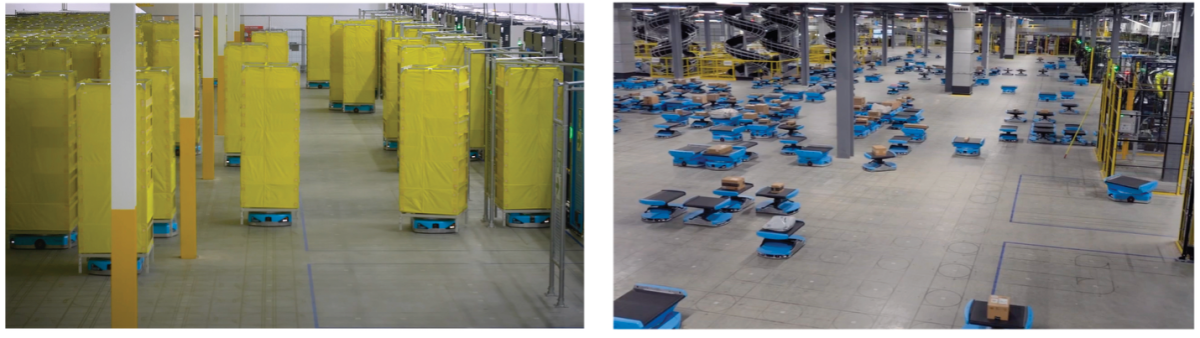
Robots laden with storage pods at a fulfillment center (left) and with packages at a sortation center (right).

One question I get a lot is why we would need a foundation model to predict robots’ locations. After all, we know exactly what algorithms the robots are running; can’t we just simulate their interactions and get an answer that way?

There are two obstacles to this approach. First, accurately simulating the interactions of a couple thousand robots faster than real time is prohibitively resource intensive: our fleet already uses all available computation time to optimize its plans. In contrast, a learned model can quickly infer how traffic will likely play out.

Second, we see predicting robot locations as, really, a pretraining task, which we use to teach an AI to understand traffic flow. We believe that, just as pretraining on next-word prediction enabled chatbots to answer a diverse range of questions, pretraining on location prediction can enable an AI to generate general solutions for mobile-robot fleets.

Related content
Unique end-of-arm tools with three-dimensional force sensors and innovative control algorithms enable robotic arms to “pick” items from and “stow” items in fabric storage pods.

The success of a foundation model depends on having adequate training data, which is one of the areas where Amazon has an advantage. At the same time that we announced DeepFleet, we also announced the deployment of our millionth robot to Amazon FCs and sortation centers. We have literally billions of hours of robot navigation data that we can use to train our foundation models.

And of course, Amazon is also the largest provider of cloud computing resources, so we have the computational capacity to train and deploy models large enough to benefit from all that training data. One of our paper’s key findings is that, like other foundation models, a robot fleet foundation model continues to improve as the volume of training data increases.

In some ways, it’s natural to adapt LLM architectures to the problem of predicting robot location. An LLM takes in a sequence of words and projects that sequence forward, one word at a time. Similarly, a robot navigation model would take in a sequence of robot states or floor states and project it forward, one state at a time.

In other ways, the adaptation isn’t so straightforward. With LLMs, it’s clear what the inputs and outputs should be: words (or more precisely word parts, or tokens). But how about with robot navigation? Should the input to the model be the state of a single robot, and you produce a floor map by aggregating the outputs of multiple models? Or should the inputs and outputs include the state of the whole floor? And if they do, how do you represent the floor? As a set of features relative to the robot location? As an image? As a graph? And how do you handle time? Is each input to the model a snapshot taken at a regular interval? Or does each input represent a discrete action, whenever it took place?

We experimented with four distinct models that answer these questions in different ways. The basic setup is the same for all of them: we model the floor of an FC or sortation center as a grid whose cells can be occupied by robots, which are either laden (storage pods in an FC, packages in a sortation center) or unladen and have fixed orientations; obstacles; or storage or drop-off locations. Unoccupied cells make up travel lanes.
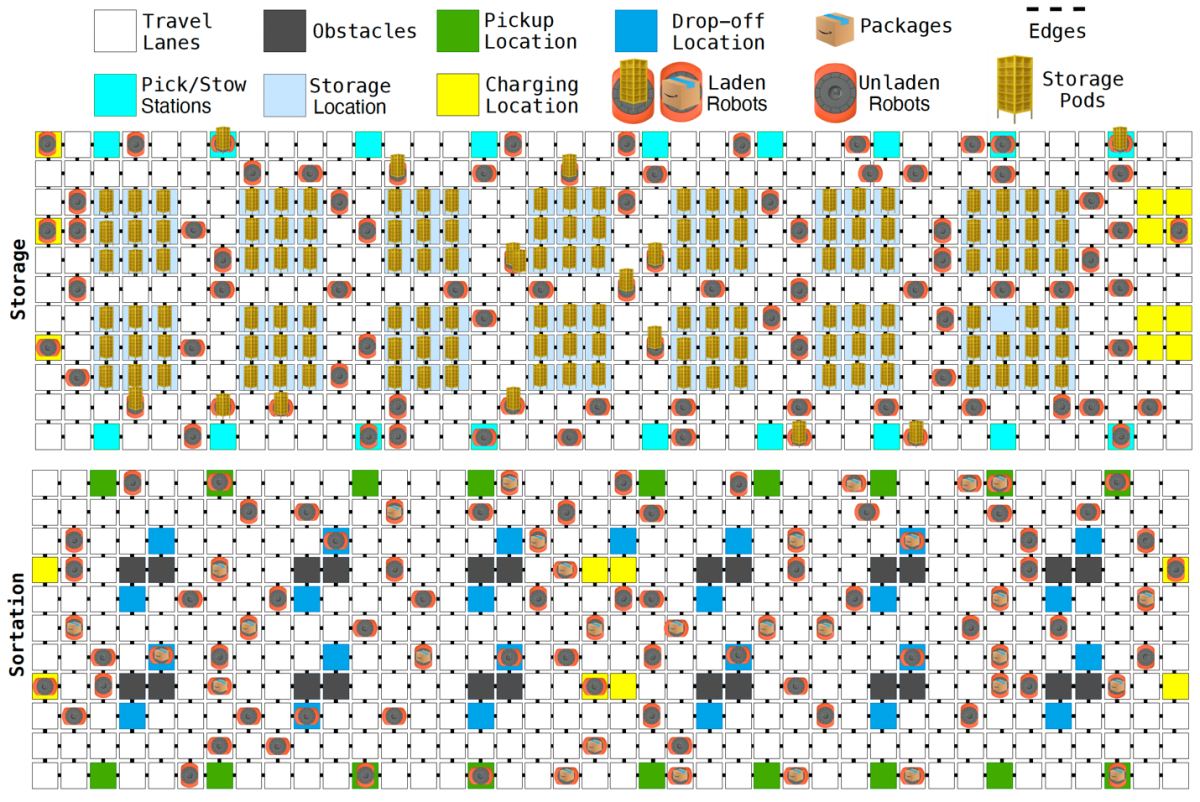
Sample models of a fulfillment center (top) and a sortation center (bottom).

Like most machine learning systems of the past 10 years, our models produce embeddings of input data, or vector representations that capture data features useful for predictive tasks. All of our models make use of the Transformer architecture that is the basis of today’s LLMs. The Transformer’s characteristic feature is the attention mechanism: when determining its next output, the model determines how much it should attend to each data item it’s already seen — or to supplementary data. One of our models also uses a convolutional neural network, the standard model for image processing, while another uses a graph neural network to capture spatial relationships.

DeepFleet is the collective name for all of our models. Individually, they are the robot-centric model, the robot-floor model, the image-floor model, and the graph-floor model.

1. The robot-centric model

The robot-centric model focuses on one robot at a time — the “ego robot” — and builds a representation of its immediate environment. The model’s encoder produces an embedding of the ego robot’s state — where it is, what direction it’s facing, where it’s headed, whether it’s laden or unladen, and so on. The encoder also produces embeddings of the states of the 30 robots nearest the ego robot; the 100 nearest grid cells; and the 100 nearest objects (drop-off chutes, storage pods, charging stations, and so on).

A Transformer combines these embeddings into a single embedding, and a sequence of such embeddings — representing a sequence of states and actions the ego robot took — passes to a decoder. On the basis of that sequence, the decoder predicts the robot’s next action. This process happens in parallel for every robot on the floor. Updating the state of the floor as a whole is a matter of sequentially applying each robot’s predicted action.
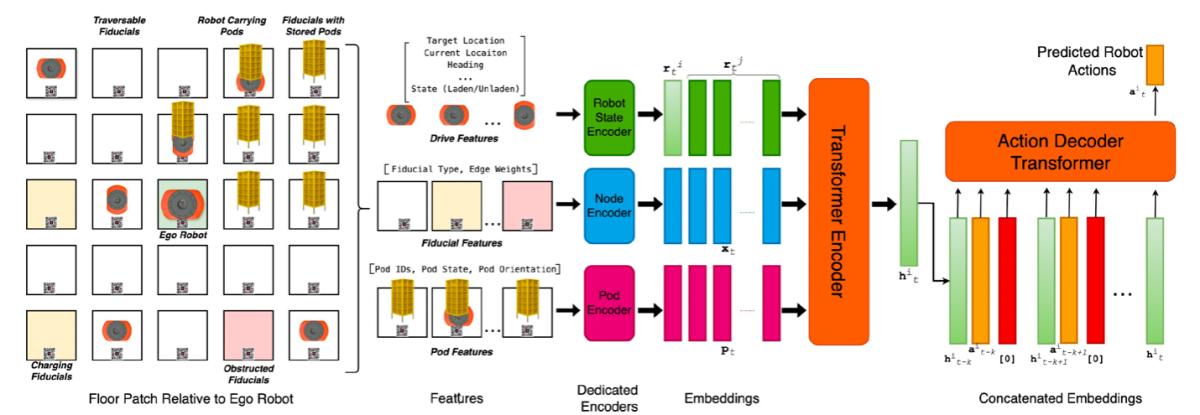
Architecture of the robot-centric model.

2. The robot-floor model

With the robot-floor model, separate encoders produce embeddings of the robot states and fixed features of the floor cells. As the only changes to the states of the floor cells are the results of robotic motion, the floor state requires only a single embedding.

At decoding time, we use cross-attention between the robot embeddings and the floor state embedding to produce a new embedding for each robot that factors in floor state information. Then, for each robot, we use cross-attention between its updated embedding and those of each of the other robots to produce a final embedding, which captures both robot-robot and robot-floor relationships. The last layer of the model — the output head — uses these final embeddings to predict each robot’s next action.
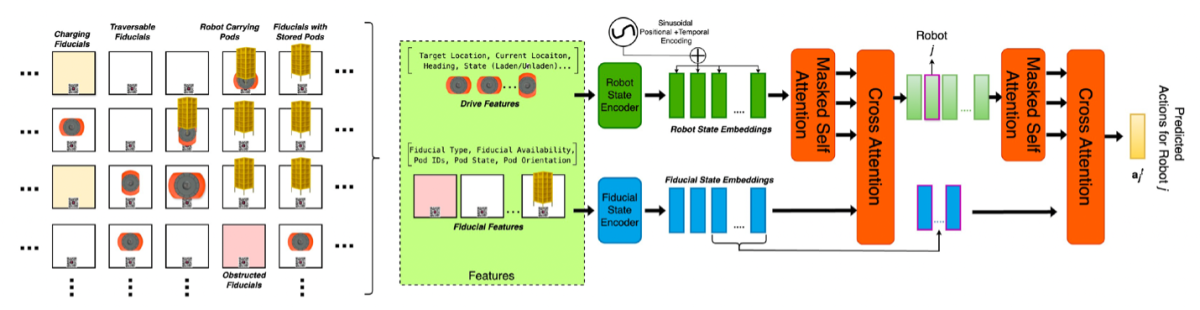
The architecture of the robot-floor model..png
The architecture of the robot-floor model.

3. The image-floor model

Convolutional neural networks step through an input image, applying different filters to fixed-size blocks of pixels. Each filter establishes a separate processing channel through the network. Typically, the filters are looking for different image features, such as contours with particular shapes and orientations.

In our case, however, the “pixels” are cells of the floor grid, and each channel is dedicated to a separate cell feature. There are static features, such as fixed objects in particular cells, and dynamic features, such as the locations of the robots and their states.

Related content
Generative AI supports the creation, at scale, of complex, realistic driving scenarios that can be directed to specific locations and environments.

In each channel, representations of successive states of the floor are flattened — converted from 2-D grids to 1-D vectors — and fed to a Transformer. The Transformer’s attention mechanism can thus attend to temporal and spatial features simultaneously. The Transformer’s output is an encoding of the next floor state, which a convolutional decoder converts back to a 2-D representation.

4. The graph-floor model

A natural way to model the FC or sortation center floor is as a graph whose nodes are floor cells and whose edges encode the available movements between cells (for example, a robot may not move into a cell occupied by another object). We convert such a spatial graph into a spatiotemporal graph by adding temporal edges that connect each node to itself at a later time step.

Next, in the approach made standard by graph neural networks, we use a Transformer to iteratively encode the spatiotemporal graph as a set of node embeddings. With each iteration, a node’s embedding factors in information about nodes farther away from it in the graph. In parallel, the model also builds up a set of edge embeddings.

Each encoding block also includes an attention mechanism that uses the edge embeddings to compute attention scores between node embeddings. The output embedding thus factors in information about the distances between nodes, so it can capture long-range effects.

From the final set of node embeddings, we can decode a prediction of where each robot is, whether it is moving, what direction it is heading, etc.
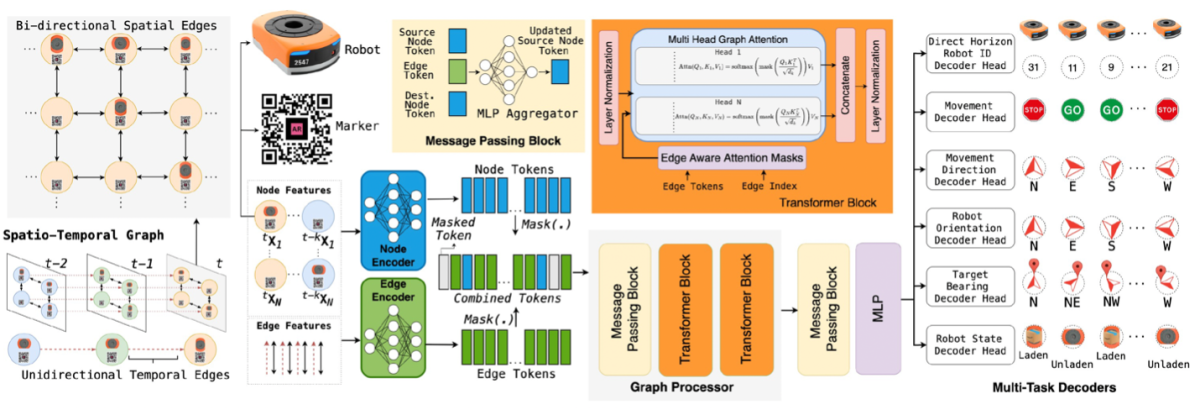
The architecture of the graph-floor model.

Evaluation

We used two metrics to evaluate all four models’ performance. The first is dynamic-time-warping (DTW) distance between predictions and the ground truth across multiple dimensions, including robot position, speed, state, and the timing of load and unload events. The second metric is congestion delay error (CDE), or the relative error between delay predictions and ground truth.

Overall, the robot-centric model performed best, with the top scores on both CDE and the DTW distance on position and state predictions, but the robot-floor model achieved the top score on DTW distance for timing estimation. The graph-floor model didn’t fare quite as well, but its results were still strong at a significantly lower parameter count — 13 million, versus 97 million for the robot-centric model and 840 million for the robot-floor model.

The image-floor model didn’t work well. We suspect that this is because the convolutional filters of a convolutional neural network are designed to abstract away from pixel-level values to infer larger-scale image features, like object classifications. We were trying to use convolutional neural networks for pixel-level predictions, which they may not be suited for.

We also conducted scaling experiments with the robot-centric and graph-floor models, which showed that, indeed, model performance improved with increases in the volume of training data — an encouraging sign, given the amount of data we have at our disposal.

On the basis of these results, we are continuing to develop the robot-centric, robot-floor, and graph-floor models, initially using them to predict congestion, with the longer-term goal of using them to produce outputs like assignments of robots to specific retrieval tasks and target locations. You can read the full paper on arXiv.

Research areas

Related content

JP, 13, Tokyo
Are you a Graduate Student interested in machine learning, natural language processing, computer vision, automated reasoning, robotics? We are looking for skilled scientists capable of putting theory into practice through experimentation and invention, leveraging science techniques and implementing systems to work on massive datasets in an effort to tackle never-before-solved problems. A successful candidate will be a self-starter comfortable with ambiguity, strong attention to detail, and the ability to work in a fast-paced, ever-changing environment. As an Applied Scientist, you will own the design and development of end-to-end systems. You’ll have the opportunity to create technical roadmaps, and drive production level projects that will support Amazon Science. You will work closely with Amazon scientists, and other science interns to develop solutions and deploy them into production. The ideal scientist must have the ability to work with diverse groups of people and cross-functional teams to solve complex business problems. Key job responsibilities Amazon Science gives insight into the company’s approach to customer-obsessed scientific innovation. Amazon fundamentally believes that scientific innovation is essential to being the most customer-centric company in the world. It’s the company’s ability to have an impact at scale that allows us to attract some of the brightest minds in artificial intelligence and related fields. Amazon Scientist use our working backwards method to enrich the way we live and work. A day in the life Come teach us a few things, and we’ll teach you a few things as we navigate the most customer-centric company on Earth.
US, MA, N.reading
Amazon Industrial Robotics is seeking exceptional talent to help develop the next generation of advanced robotics systems that will transform automation at Amazon's scale. We're building revolutionary robotic systems that combine cutting-edge AI, sophisticated control systems, and advanced mechanical design to create adaptable automation solutions capable of working safely alongside humans in dynamic environments. This is a unique opportunity to shape the future of robotics and automation at an unprecedented scale, working with world-class teams pushing the boundaries of what's possible in robotic manipulation, locomotion, and human-robot interaction. As an Applied Scientist in Sensing, you will develop innovative and complex sensing systems for our emerging robotic solutions and improve existing on-robot sensing to optimize performance and enhance customer experience. The ideal candidate has demonstrated experience designing and troubleshooting custom sensor systems from the ground up. They enjoy analytical problem solving and possess practical knowledge of robotic design, fabrication, assembly, and rapid prototyping. They thrive in an interdisciplinary environment and have led the development of complex sensing systems. Key job responsibilities - Design and adapt holistic on-robot sensing solutions for ambiguous problems with fluid requirements - Mentor and develop junior scientists and engineers - Work with an interdisciplinary team to execute product designs from concept to production including specification, design, prototyping, validation and testing - Have responsibility for the designs and performance of a sensing system design - Work with the Operations, Manufacturing, Supply Chain and Quality organizations as well as vendors to ensure a fast development and delivery of the sensing concepts to the team - Develop overall safety concept of the sensing platform - Exhibit role model behaviors of applied science best practices, thorough and predictive analysis and cradle to grave ownership
US, CA, San Francisco
Amazon has launched a new research lab in San Francisco to develop foundational capabilities for useful AI agents. We’re enabling practical AI to make our customers more productive, empowered, and fulfilled. In particular, our work combines large language models (LLMs) with reinforcement learning (RL) to solve reasoning, planning, and world modeling in both virtual and physical environments. Our research builds on that of Amazon’s broader AGI organization, which recently introduced Amazon Nova, a new generation of state-of-the-art foundation models (FMs). Our lab is a small, talent-dense team with the resources and scale of Amazon. Each team in the lab has the autonomy to move fast and the long-term commitment to pursue high-risk, high-payoff research. We’re entering an exciting new era where agents can redefine what AI makes possible. We’d love for you to join our lab and build it from the ground up! Key job responsibilities You will be responsible for maintaining our task management system which supports many internal and external stakeholders and ensures we are able to continue adding orders of magnitude more data and reliability.
IN, KA, Bengaluru
You will be working with a unique and gifted team developing exciting products for consumers. The team is a multidisciplinary group of engineers and scientists engaged in a fast paced mission to deliver new products. The team faces a challenging task of balancing cost, schedule, and performance requirements. You should be comfortable collaborating in a fast-paced and often uncertain environment, and contributing to innovative solutions, while demonstrating leadership, technical competence, and meticulousness. Your deliverables will include development of thermal solutions, concept design, feature development, product architecture and system validation through to manufacturing release. You will support creative developments through application of analysis and testing of complex electronic assemblies using advanced simulation and experimentation tools and techniques. Key job responsibilities In this role, you will: - Own thermal design for consumer electronics products at the system level, proposing thermal architecture and aligning with functional leads - Perform CFD simulations using tools such as Star-CCM+ or FloEFD to assess thermal feasibility, identify risks, and propose mitigation options - Generate data processing, statistical analysis, and test automation scripts to improve data consistency, insight quality, and team efficiency - Plan and execute thermal validation activities for devices and SoC packages, including test setup definition, data review, and issue tracking - Work closely with cross-functional and cross-geo teams to support product decisions, generate thermal specifications, and align on thermal requirements - Prepare clear summaries and reports on thermal results, risks, and observations for review by cross-functional leads About the team Amazon Lab126 is an inventive research and development company that designs and engineers high-profile consumer electronics. Lab126 began in 2004 as a subsidiary of Amazon.com, Inc., originally creating the best-selling Kindle family of products. Since then, we have produced innovative devices like Fire tablets, Fire TV and Amazon Echo. What will you help us create?
US, MA, North Reading
At Amazon Robotics, we design advanced robotic systems capable of intelligent perception, learning, and action alongside humans, all on a large scale. Our goal is to develop robots that increase productivity and efficiency at the Amazon fulfillment centers while ensuring the safety of workers. We are seeking an Applied Scientist to develop innovative, scalable solutions in feedback control and state estimation for robotic systems, with a focus on contact-rich manipulation tasks. In this role, you will formulate physics-based models of robotic systems, perform analytical and numerical studies, and design control and estimation algorithms that integrate fundamental principles with data-driven techniques. You will collaborate with a world-class team of experts in perception, machine learning, motion planning, and feedback controls to innovate and develop solutions for complex real-world problems. As part of your work, you will investigate applicable academic and industry research to develop, implement, and test solutions that support product features. You will also design and validate production designs. To succeed in this role, you should demonstrate a strong working knowledge of physical systems, a desire to learn from new challenges, and the problem-solving and communication skills to work within a highly interactive and experienced team. Candidates must show a hands-on passion for their work and the ability to communicate their ideas and concepts both verbally and visually. Key job responsibilities - Research, design, implement, and evaluate feedback control, estimation, and motion-planning algorithms, ensuring effective integration with perception, manipulation, and system-level components. - Develop experiments, simulations, and hardware prototypes to validate control algorithms, and optimization techniques in contact-rich manipulation and other challenging scenarios. - Collaborate with software engineering teams to enable scalable, real-time, and maintainable implementations of algorithms in production systems. - Partner with cross-functional teams across hardware, systems engineering, science, and operations to transition algorithms from early prototyping to robust, production-ready solutions. - Engage with stakeholders at all levels to iterate on system design, define requirements, and drive integration of control and estimation capabilities into Amazon Robotics platforms. A day in the life Amazon offers a full range of benefits that support you and eligible family members, including domestic partners and their children. Benefits can vary by location, the number of regularly scheduled hours you work, length of employment, and job status such as seasonal or temporary employment. The benefits that generally apply to regular, full-time employees include: 1. Medical, Dental, and Vision Coverage 2. Maternity and Parental Leave Options 3. Paid Time Off (PTO) 4. 401(k) Plan If you are not sure that every qualification on the list above describes you exactly, we'd still love to hear from you! At Amazon, we value people with unique backgrounds, experiences, and skillsets. If you’re passionate about this role and want to make an impact on a global scale, please apply!
GB, London
Come build the future of entertainment with us. Are you interested in shaping the future of movies and television? Do you want to define the next generation of how and what Amazon customers are watching? Prime Video is a premium streaming service that offers customers a vast collection of TV shows and movies - all with the ease of finding what they love to watch in one place. We offer customers thousands of popular movies and TV shows including Amazon Originals and exclusive licensed content to exciting live sports events. We also offer our members the opportunity to subscribe to add-on channels which they can cancel at anytime and to rent or buy new release movies and TV box sets on the Prime Video Store. Prime Video is a fast-paced, growth business - available in over 200 countries and territories worldwide. The team works in a dynamic environment where innovating on behalf of our customers is at the heart of everything we do. If this sounds exciting to you, please read on. We are seeking a Data Scientist to develop scalable models that uncover key insights into how, why and when customers engage with content on Prime Video. Key job responsibilities In this role you will work closely with business stakeholders and other data scientists to develop predictive models, forecast key business metrics, dive deep on the customer and content related factors that drive engagement and create mechanisms and infrastructure to deploy complex models and generate insights at scale. You will have the opportunity to work with large datasets, build with AWS to deploy machine learning and forecasting models while making a significant impact on how Prime Video makes content investment and selection decisions.
IN, KA, Bengaluru
Amazon’s Last Mile Team is looking for a passionate individual with strong machine learning and GenAI engineering skills to join its Last Mile Science team in the endeavor of designing and improving the most complex planning of delivery network in the world. Last Mile builds global solutions that enable Amazon to attract an elastic supply of drivers, companies, and assets needed to deliver Amazon's and other shippers' volumes at the lowest cost and with the best customer delivery experience. Last Mile Science team owns the core decision models in the space of jurisdiction planning, delivery channel and modes network design, capacity planning for on the road and at delivery stations, routing inputs estimation and optimization, fleet planning. Our research has direct impact on customer experience, driver and station associate experience, Delivery Service Partner (DSP)’s success and the sustainable growth of Amazon. Optimizing the last mile delivery requires deep understanding of transportation, supply chain management, pricing strategies and forecasting, and the GenAI approaches for a diverse range of problems to solve. Only through innovative and strategic thinking, we will make the right capital investments in technology, assets and infrastructures that allows for long-term success. Our team members have an opportunity to be on the forefront of supply chain thought leadership by working on some of the most difficult problems in the industry with some of the best product managers, scientists, and software engineers in the industry. Key job responsibilities Candidates will be responsible for developing solutions to better manage and optimize delivery capacity in the last mile network. The successful candidate should have solid research experience in one or more technical areas of Machine Learning or Large Language Models. These positions will focus on identifying and analyzing opportunities to improve existing algorithms and also on optimizing the system policies across the management of external delivery service providers and internal planning strategies. They require superior logical thinkers who are able to quickly approach large ambiguous problems, turn high-level business requirements into mathematical models, identify the right solution approach, and contribute to the software development for production systems. To support their proposals, candidates should be able to independently mine and analyze data, and be able to use any necessary programming and statistical analysis software to do so. Successful candidates must thrive in fast-paced environments, which encourage collaborative and creative problem solving, be able to measure and estimate risks, constructively critique peer research, and align research focuses with the Amazon's strategic needs.
AT, Graz
Are you a MS or PhD student interested in a 2026 internship in the field of machine learning, deep learning, generative AI, large language models and speech technology, robotics, computer vision, optimization, operations research, quantum computing, automated reasoning, or formal methods? If so, we want to hear from you! We are looking for students interested in using a variety of domain expertise to invent, design and implement state-of-the-art solutions for never-before-solved problems. You can find more information about the Amazon Science community as well as our interview process via the links below; https://www.amazon.science/ https://amazon.jobs/content/en/career-programs/university/science https://amazon.jobs/content/en/how-we-hire/university-roles/applied-science Key job responsibilities As an Applied Science Intern, you will own the design and development of end-to-end systems. You’ll have the opportunity to write technical white papers, create roadmaps and drive production level projects that will support Amazon Science. You will work closely with Amazon scientists and other science interns to develop solutions and deploy them into production. You will have the opportunity to design new algorithms, models, or other technical solutions whilst experiencing Amazon’s customer focused culture. The ideal intern must have the ability to work with diverse groups of people and cross-functional teams to solve complex business problems. A day in the life At Amazon, you will grow into the high impact person you know you’re ready to be. Every day will be filled with developing new skills and achieving personal growth. How often can you say that your work changes the world? At Amazon, you’ll say it often. Join us and define tomorrow. Some more benefits of an Amazon Science internship include; • All of our internships offer a competitive stipend/salary • Interns are paired with an experienced manager and mentor(s) • Interns receive invitations to different events such as intern program initiatives or site events • Interns can build their professional and personal network with other Amazon Scientists • Interns can potentially publish work at top tier conferences each year About the team Applicants will be reviewed on a rolling basis and are assigned to teams aligned with their research interests and experience prior to interviews. Start dates are available throughout the year and durations can vary in length from 3-6 months for full time internships. This role may available across multiple locations in the EMEA region (Austria, Estonia, France, Germany, Ireland, Israel, Italy, Jordan, Luxembourg, Netherlands, Poland, Romania, Spain, South Africa, UAE, and UK). Please note these are not remote internships.
IN, HR, Gurugram
Lead ML teams building large-scale forecasting and optimization systems that power Amazon’s global transportation network and directly impact customer experience and cost. As an Applied Science Manager, you will set scientific direction, mentor applied scientists, and partner with engineering and product leaders to deliver production-grade ML solutions at massive scale. Key job responsibilities 1. Lead and grow a high-performing team of Applied Scientists, providing technical guidance, mentorship, and career development. 2. Define and own the scientific vision and roadmap for ML solutions powering large-scale transportation planning and execution. 3. Guide model and system design across a range of techniques, including tree-based models, deep learning (LSTMs, transformers), LLMs, and reinforcement learning. 4. Ensure models are production-ready, scalable, and robust through close partnership with stakeholders. Partner with Product, Operations, and Engineering leaders to enable proactive decision-making and corrective actions. 5. Own end-to-end business metrics, directly influencing customer experience, cost optimization, and network reliability. 6. Help contribute to the broader ML community through publications, conference submissions, and internal knowledge sharing. A day in the life Your day includes reviewing model performance and business metrics, guiding technical design and experimentation, mentoring scientists, and driving roadmap execution. You’ll balance near-term delivery with long-term innovation while ensuring solutions are robust, interpretable, and scalable. Ultimately, your work helps improve delivery reliability, reduce costs, and enhance the customer experience at massive scale.
IL, Haifa
Come join the AWS Agentic AI science team in building the next generation models for intelligent automation. AWS, the world-leading provider of cloud services, has fostered the creation and growth of countless new businesses, and is a positive force for good. Our customers bring problems that will give Applied Scientists like you endless opportunities to see your research have a positive and immediate impact in the world. You will have the opportunity to partner with technology and business teams to solve real-world problems, have access to virtually endless data and computational resources, and to world-class engineers and developers that can help bring your ideas into the world. As part of the team, we expect that you will develop innovative solutions to hard problems, and publish your findings at peer reviewed conferences and workshops. We are looking for world class researchers with experience in one or more of the following areas - autonomous agents, API orchestration, Planning, large multimodal models (especially vision-language models), reinforcement learning (RL) and sequential decision making.