











Multiagent AI for generating chain-of-thought training data

Using ensembles of agents to generate and refine interactions annotated with chains of thought improves performance on a battery of benchmarks by an average of 29%.

Chain-of-thought reasoning, in which a large language model (LLM) is asked not only to perform multistep actions but to explain its reasons for taking the steps it does, has been shown to improve LLMs’ reasoning capability. One promising application of chain-of-thought (CoT) reasoning is ensuring that LLMs adhere to responsible-AI policies.

Using CoT to optimize an LLM for policy adherence requires high-quality training data annotated with chains of thoughts. But hiring human annotators to generate such training data is expensive and time consuming.

Inspired by current work on incorporating artificial experts into the standard LLM training pipeline, researchers in Amazon’s Artificial General Intelligence organization have begun exploring the possibility of using ensembles of AI agents to generate high-quality CoT data. We report the results of our initial experiments in a paper we presented at this year’s meeting of the Association for Computational Linguistics (ACL).

Using two different LLMs and five different datasets, we compared models fine tuned on data created through our multiagent-deliberation approach to both baseline pretrained models and models fine tuned through supervised fine tuning on conventional data.
Related content
Novel three-pronged approach combines claim-level evaluations, chain-of-thought reasoning, and classification of hallucination error types.

Our approach achieves an increase in average safety (in-domain, out-of-domain, and jailbreaks) of 96% relative to the baseline and 73% relative to the conventionally fine-tuned model, when using a non-safety trained model (Mixtral). The increases were 12% and 44%, respectively, on a safety-trained model (Qwen).

Multiagent deliberation

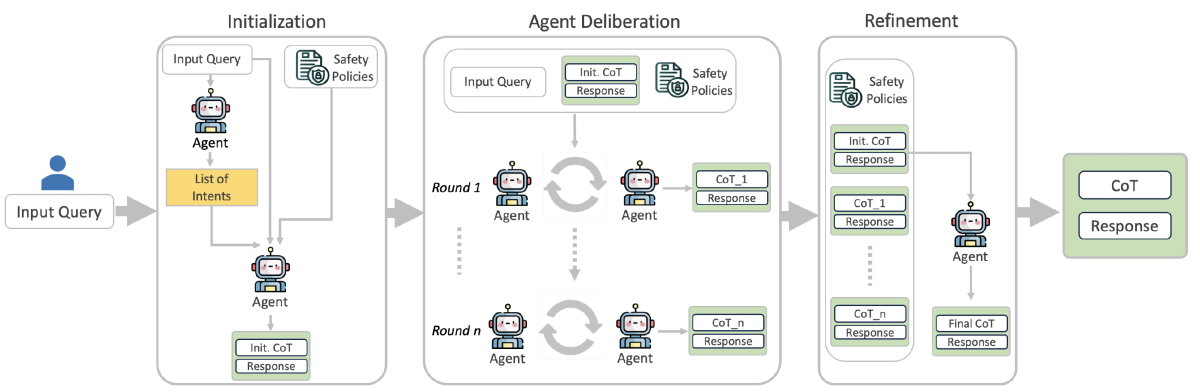
Our approach divides the task of generating policy-compliant chains of thought into three stages, each of which uses LLMs: intent decomposition, deliberation, and refinement.

During intent decomposition, an LLM receives the user query and identifies explicit and implicit user intents. These, together with the query, are then passed to another LLM, which generates an initial CoT.

Deliberation is an iterative process in which multiple LLMs (agents) expand the CoT in sequential fashion, factoring in a defined set of policies. Each agent is prompted to review and correct the version of the CoT it receives — or to confirm that it’s good as is. This stage ends when an agent judges the CoT complete or when a predefined deliberation budget is exhausted.

Finally, in the refinement stage, an LLM takes the outputs of the deliberation stage and post-processes them to filter out redundant, deceptive, and policy-inconsistent thoughts.
Multiagent-deliberation framework.png
A schematic of our multiagent-deliberation framework to generate safety-embedded CoTs.

Evaluation

Following prior work, we analyze the quality of the generated CoTs by measuring three fine-grained attributes: (1) relevance, (2) coherence, and (3) completeness. Each attribute is evaluated on a scale from 1 to 5, where 1 represents the lowest quality and 5 represents the highest. As test data, we use examples from several standard CoT benchmark datasets.

Related content
Large language models’ emergent abilities are improving with scale; as scale grows, where are LLMs heading? Insights from Ray Solomonoff’s theory of induction and stochastic realization theory may help us envision — and guide — the limits of scaling.

We also assess faithfulness along three dimensions: (1) faithfulness between policy and the generated CoT; (2) faithfulness between policy and the generated response; and (3) faithfulness between the generated CoT and the final response. We use an LLM fine tuned as an auto-grader to evaluate faithfulness on a scale from 1 to 5, where 1 indicates minimal faithfulness, and 5 indicates complete adherence.

As can be seen in the table below, using our framework provides quality improvements across all metrics, with an improvement of more than 10% in CoTs’ policy faithfulness.
 
Average auto-grader scores on the generated-CoT datasets (1-5 scale), including general-reasoning metrics to evaluate the quality of CoTs and faithfulness metrics to evaluate policy adherence.

Metric

LLM_ZS

AIDSAFE

delta

Relevance

4.66

4.68

0.43%

Coherence

4.93

4.96

0.61%

Completeness

4.86

4.92

1.23%

CoTs’ faithfulness (policy)

3.85

4.27

10.91%

Response faithfulness (policy)

4.85

4.91

1.24%

Response faithfulness (CoT)

4.99

5

0.20%

Fine tuning

We use several benchmarks to measure the performance improvements provided by our generated CoT data: Beavertails (for safety), WildChat, XSTest (for overrefusal, or erroneously flagging safe generations as unsafe), MMLU (for utility), and StrongREJECT (for jailbreak robustness).
Related content
Novel graph-based, adversarial, agentic method for generating training examples helps identify — and mitigate — "overrefusal".

We used two different LLMs in our tests, the widely used open-source models Qwen and Mixtral. The base versions of these models provide one baseline, and we add another baseline by fine-tuning these models with only the prompts and responses from the original dataset — not the generated CoTs. Our method shows significant improvements over baseline, specifically on safety and jailbreak robustness, with some trade-offs on utility and overrefusal.

Below are the results of evaluation of the supervised fine-tuned (SFT) model. "Base" denotes the LLM without SFT, SFT_OG denotes the model SFT’d on the original response data without any CoTs, and SFT_DB denotes the model SFT’d on our generated CoTs and responses. (If the full table doesn't fit on your browser, try scrolling right.)

LLM: Mixtral

Eval

Dimension

Metric

Dataset

Base

SFT_OG

SFT_DB (ours)

Safety

Safe response

rate

Beavertails

76

79.57

96

WildChat

31

33.5

85.95

Overrefusal

1-Overrefuse

rate

XSTest

98.8

87.6

91.84

Utility

Answer

accuracy

MMLU

35.42

31.38

34.51

Jailbreak Robustness

Safe response

rate

StrongREJECT

51.09

67.01

94.04

LLM: Qwen

Eval

Dimension

Metric

Dataset

Base

SFT_OG

SFT_DB (ours)

Safety

Safe response

rate

Beavertails

94.14

87.95

97

WildChat


-


-


-

95.5

59.42

96.5

Overrefusal

1-Overrefuse

rate

XSTest

99.2

98

93.6

Utility

Answer

accuracy

MMLU

75.78

55.73

60.52

Jailbreak Robustness

Safe response

rate

StrongREJECT

72.84

59.48

95.39

Acknowledgements: We would like to acknowledge our coauthors and collaborators, Kai-Wei Chang, Ninareh Mehrabi, Anil Ramakrishna, Xinyan Zhao, Aram Galstyan, Richard Zemel, and Rahul Gupta, for their contributions.

Research areas

Related content

JP, 13, Tokyo
Are you a Graduate Student interested in machine learning, natural language processing, computer vision, automated reasoning, robotics? We are looking for skilled scientists capable of putting theory into practice through experimentation and invention, leveraging science techniques and implementing systems to work on massive datasets in an effort to tackle never-before-solved problems. A successful candidate will be a self-starter comfortable with ambiguity, strong attention to detail, and the ability to work in a fast-paced, ever-changing environment. As an Applied Scientist, you will own the design and development of end-to-end systems. You’ll have the opportunity to create technical roadmaps, and drive production level projects that will support Amazon Science. You will work closely with Amazon scientists, and other science interns to develop solutions and deploy them into production. The ideal scientist must have the ability to work with diverse groups of people and cross-functional teams to solve complex business problems. Key job responsibilities Amazon Science gives insight into the company’s approach to customer-obsessed scientific innovation. Amazon fundamentally believes that scientific innovation is essential to being the most customer-centric company in the world. It’s the company’s ability to have an impact at scale that allows us to attract some of the brightest minds in artificial intelligence and related fields. Amazon Scientist use our working backwards method to enrich the way we live and work. A day in the life Come teach us a few things, and we’ll teach you a few things as we navigate the most customer-centric company on Earth.
US, MA, N.reading
Amazon Industrial Robotics is seeking exceptional talent to help develop the next generation of advanced robotics systems that will transform automation at Amazon's scale. We're building revolutionary robotic systems that combine cutting-edge AI, sophisticated control systems, and advanced mechanical design to create adaptable automation solutions capable of working safely alongside humans in dynamic environments. This is a unique opportunity to shape the future of robotics and automation at an unprecedented scale, working with world-class teams pushing the boundaries of what's possible in robotic manipulation, locomotion, and human-robot interaction. As an Applied Scientist in Sensing, you will develop innovative and complex sensing systems for our emerging robotic solutions and improve existing on-robot sensing to optimize performance and enhance customer experience. The ideal candidate has demonstrated experience designing and troubleshooting custom sensor systems from the ground up. They enjoy analytical problem solving and possess practical knowledge of robotic design, fabrication, assembly, and rapid prototyping. They thrive in an interdisciplinary environment and have led the development of complex sensing systems. Key job responsibilities - Design and adapt holistic on-robot sensing solutions for ambiguous problems with fluid requirements - Mentor and develop junior scientists and engineers - Work with an interdisciplinary team to execute product designs from concept to production including specification, design, prototyping, validation and testing - Have responsibility for the designs and performance of a sensing system design - Work with the Operations, Manufacturing, Supply Chain and Quality organizations as well as vendors to ensure a fast development and delivery of the sensing concepts to the team - Develop overall safety concept of the sensing platform - Exhibit role model behaviors of applied science best practices, thorough and predictive analysis and cradle to grave ownership
US, CA, San Francisco
Amazon has launched a new research lab in San Francisco to develop foundational capabilities for useful AI agents. We’re enabling practical AI to make our customers more productive, empowered, and fulfilled. In particular, our work combines large language models (LLMs) with reinforcement learning (RL) to solve reasoning, planning, and world modeling in both virtual and physical environments. Our research builds on that of Amazon’s broader AGI organization, which recently introduced Amazon Nova, a new generation of state-of-the-art foundation models (FMs). Our lab is a small, talent-dense team with the resources and scale of Amazon. Each team in the lab has the autonomy to move fast and the long-term commitment to pursue high-risk, high-payoff research. We’re entering an exciting new era where agents can redefine what AI makes possible. We’d love for you to join our lab and build it from the ground up! Key job responsibilities You will be responsible for maintaining our task management system which supports many internal and external stakeholders and ensures we are able to continue adding orders of magnitude more data and reliability.
IN, KA, Bengaluru
You will be working with a unique and gifted team developing exciting products for consumers. The team is a multidisciplinary group of engineers and scientists engaged in a fast paced mission to deliver new products. The team faces a challenging task of balancing cost, schedule, and performance requirements. You should be comfortable collaborating in a fast-paced and often uncertain environment, and contributing to innovative solutions, while demonstrating leadership, technical competence, and meticulousness. Your deliverables will include development of thermal solutions, concept design, feature development, product architecture and system validation through to manufacturing release. You will support creative developments through application of analysis and testing of complex electronic assemblies using advanced simulation and experimentation tools and techniques. Key job responsibilities In this role, you will: - Own thermal design for consumer electronics products at the system level, proposing thermal architecture and aligning with functional leads - Perform CFD simulations using tools such as Star-CCM+ or FloEFD to assess thermal feasibility, identify risks, and propose mitigation options - Generate data processing, statistical analysis, and test automation scripts to improve data consistency, insight quality, and team efficiency - Plan and execute thermal validation activities for devices and SoC packages, including test setup definition, data review, and issue tracking - Work closely with cross-functional and cross-geo teams to support product decisions, generate thermal specifications, and align on thermal requirements - Prepare clear summaries and reports on thermal results, risks, and observations for review by cross-functional leads About the team Amazon Lab126 is an inventive research and development company that designs and engineers high-profile consumer electronics. Lab126 began in 2004 as a subsidiary of Amazon.com, Inc., originally creating the best-selling Kindle family of products. Since then, we have produced innovative devices like Fire tablets, Fire TV and Amazon Echo. What will you help us create?
US, MA, North Reading
At Amazon Robotics, we design advanced robotic systems capable of intelligent perception, learning, and action alongside humans, all on a large scale. Our goal is to develop robots that increase productivity and efficiency at the Amazon fulfillment centers while ensuring the safety of workers. We are seeking an Applied Scientist to develop innovative, scalable solutions in feedback control and state estimation for robotic systems, with a focus on contact-rich manipulation tasks. In this role, you will formulate physics-based models of robotic systems, perform analytical and numerical studies, and design control and estimation algorithms that integrate fundamental principles with data-driven techniques. You will collaborate with a world-class team of experts in perception, machine learning, motion planning, and feedback controls to innovate and develop solutions for complex real-world problems. As part of your work, you will investigate applicable academic and industry research to develop, implement, and test solutions that support product features. You will also design and validate production designs. To succeed in this role, you should demonstrate a strong working knowledge of physical systems, a desire to learn from new challenges, and the problem-solving and communication skills to work within a highly interactive and experienced team. Candidates must show a hands-on passion for their work and the ability to communicate their ideas and concepts both verbally and visually. Key job responsibilities - Research, design, implement, and evaluate feedback control, estimation, and motion-planning algorithms, ensuring effective integration with perception, manipulation, and system-level components. - Develop experiments, simulations, and hardware prototypes to validate control algorithms, and optimization techniques in contact-rich manipulation and other challenging scenarios. - Collaborate with software engineering teams to enable scalable, real-time, and maintainable implementations of algorithms in production systems. - Partner with cross-functional teams across hardware, systems engineering, science, and operations to transition algorithms from early prototyping to robust, production-ready solutions. - Engage with stakeholders at all levels to iterate on system design, define requirements, and drive integration of control and estimation capabilities into Amazon Robotics platforms. A day in the life Amazon offers a full range of benefits that support you and eligible family members, including domestic partners and their children. Benefits can vary by location, the number of regularly scheduled hours you work, length of employment, and job status such as seasonal or temporary employment. The benefits that generally apply to regular, full-time employees include: 1. Medical, Dental, and Vision Coverage 2. Maternity and Parental Leave Options 3. Paid Time Off (PTO) 4. 401(k) Plan If you are not sure that every qualification on the list above describes you exactly, we'd still love to hear from you! At Amazon, we value people with unique backgrounds, experiences, and skillsets. If you’re passionate about this role and want to make an impact on a global scale, please apply!
GB, London
Come build the future of entertainment with us. Are you interested in shaping the future of movies and television? Do you want to define the next generation of how and what Amazon customers are watching? Prime Video is a premium streaming service that offers customers a vast collection of TV shows and movies - all with the ease of finding what they love to watch in one place. We offer customers thousands of popular movies and TV shows including Amazon Originals and exclusive licensed content to exciting live sports events. We also offer our members the opportunity to subscribe to add-on channels which they can cancel at anytime and to rent or buy new release movies and TV box sets on the Prime Video Store. Prime Video is a fast-paced, growth business - available in over 200 countries and territories worldwide. The team works in a dynamic environment where innovating on behalf of our customers is at the heart of everything we do. If this sounds exciting to you, please read on. We are seeking a Data Scientist to develop scalable models that uncover key insights into how, why and when customers engage with content on Prime Video. Key job responsibilities In this role you will work closely with business stakeholders and other data scientists to develop predictive models, forecast key business metrics, dive deep on the customer and content related factors that drive engagement and create mechanisms and infrastructure to deploy complex models and generate insights at scale. You will have the opportunity to work with large datasets, build with AWS to deploy machine learning and forecasting models while making a significant impact on how Prime Video makes content investment and selection decisions.
IN, KA, Bengaluru
Amazon’s Last Mile Team is looking for a passionate individual with strong machine learning and GenAI engineering skills to join its Last Mile Science team in the endeavor of designing and improving the most complex planning of delivery network in the world. Last Mile builds global solutions that enable Amazon to attract an elastic supply of drivers, companies, and assets needed to deliver Amazon's and other shippers' volumes at the lowest cost and with the best customer delivery experience. Last Mile Science team owns the core decision models in the space of jurisdiction planning, delivery channel and modes network design, capacity planning for on the road and at delivery stations, routing inputs estimation and optimization, fleet planning. Our research has direct impact on customer experience, driver and station associate experience, Delivery Service Partner (DSP)’s success and the sustainable growth of Amazon. Optimizing the last mile delivery requires deep understanding of transportation, supply chain management, pricing strategies and forecasting, and the GenAI approaches for a diverse range of problems to solve. Only through innovative and strategic thinking, we will make the right capital investments in technology, assets and infrastructures that allows for long-term success. Our team members have an opportunity to be on the forefront of supply chain thought leadership by working on some of the most difficult problems in the industry with some of the best product managers, scientists, and software engineers in the industry. Key job responsibilities Candidates will be responsible for developing solutions to better manage and optimize delivery capacity in the last mile network. The successful candidate should have solid research experience in one or more technical areas of Machine Learning or Large Language Models. These positions will focus on identifying and analyzing opportunities to improve existing algorithms and also on optimizing the system policies across the management of external delivery service providers and internal planning strategies. They require superior logical thinkers who are able to quickly approach large ambiguous problems, turn high-level business requirements into mathematical models, identify the right solution approach, and contribute to the software development for production systems. To support their proposals, candidates should be able to independently mine and analyze data, and be able to use any necessary programming and statistical analysis software to do so. Successful candidates must thrive in fast-paced environments, which encourage collaborative and creative problem solving, be able to measure and estimate risks, constructively critique peer research, and align research focuses with the Amazon's strategic needs.
AT, Graz
Are you a MS or PhD student interested in a 2026 internship in the field of machine learning, deep learning, generative AI, large language models and speech technology, robotics, computer vision, optimization, operations research, quantum computing, automated reasoning, or formal methods? If so, we want to hear from you! We are looking for students interested in using a variety of domain expertise to invent, design and implement state-of-the-art solutions for never-before-solved problems. You can find more information about the Amazon Science community as well as our interview process via the links below; https://www.amazon.science/ https://amazon.jobs/content/en/career-programs/university/science https://amazon.jobs/content/en/how-we-hire/university-roles/applied-science Key job responsibilities As an Applied Science Intern, you will own the design and development of end-to-end systems. You’ll have the opportunity to write technical white papers, create roadmaps and drive production level projects that will support Amazon Science. You will work closely with Amazon scientists and other science interns to develop solutions and deploy them into production. You will have the opportunity to design new algorithms, models, or other technical solutions whilst experiencing Amazon’s customer focused culture. The ideal intern must have the ability to work with diverse groups of people and cross-functional teams to solve complex business problems. A day in the life At Amazon, you will grow into the high impact person you know you’re ready to be. Every day will be filled with developing new skills and achieving personal growth. How often can you say that your work changes the world? At Amazon, you’ll say it often. Join us and define tomorrow. Some more benefits of an Amazon Science internship include; • All of our internships offer a competitive stipend/salary • Interns are paired with an experienced manager and mentor(s) • Interns receive invitations to different events such as intern program initiatives or site events • Interns can build their professional and personal network with other Amazon Scientists • Interns can potentially publish work at top tier conferences each year About the team Applicants will be reviewed on a rolling basis and are assigned to teams aligned with their research interests and experience prior to interviews. Start dates are available throughout the year and durations can vary in length from 3-6 months for full time internships. This role may available across multiple locations in the EMEA region (Austria, Estonia, France, Germany, Ireland, Israel, Italy, Jordan, Luxembourg, Netherlands, Poland, Romania, Spain, South Africa, UAE, and UK). Please note these are not remote internships.
IN, HR, Gurugram
Lead ML teams building large-scale forecasting and optimization systems that power Amazon’s global transportation network and directly impact customer experience and cost. As an Applied Science Manager, you will set scientific direction, mentor applied scientists, and partner with engineering and product leaders to deliver production-grade ML solutions at massive scale. Key job responsibilities 1. Lead and grow a high-performing team of Applied Scientists, providing technical guidance, mentorship, and career development. 2. Define and own the scientific vision and roadmap for ML solutions powering large-scale transportation planning and execution. 3. Guide model and system design across a range of techniques, including tree-based models, deep learning (LSTMs, transformers), LLMs, and reinforcement learning. 4. Ensure models are production-ready, scalable, and robust through close partnership with stakeholders. Partner with Product, Operations, and Engineering leaders to enable proactive decision-making and corrective actions. 5. Own end-to-end business metrics, directly influencing customer experience, cost optimization, and network reliability. 6. Help contribute to the broader ML community through publications, conference submissions, and internal knowledge sharing. A day in the life Your day includes reviewing model performance and business metrics, guiding technical design and experimentation, mentoring scientists, and driving roadmap execution. You’ll balance near-term delivery with long-term innovation while ensuring solutions are robust, interpretable, and scalable. Ultimately, your work helps improve delivery reliability, reduce costs, and enhance the customer experience at massive scale.
IL, Haifa
Come join the AWS Agentic AI science team in building the next generation models for intelligent automation. AWS, the world-leading provider of cloud services, has fostered the creation and growth of countless new businesses, and is a positive force for good. Our customers bring problems that will give Applied Scientists like you endless opportunities to see your research have a positive and immediate impact in the world. You will have the opportunity to partner with technology and business teams to solve real-world problems, have access to virtually endless data and computational resources, and to world-class engineers and developers that can help bring your ideas into the world. As part of the team, we expect that you will develop innovative solutions to hard problems, and publish your findings at peer reviewed conferences and workshops. We are looking for world class researchers with experience in one or more of the following areas - autonomous agents, API orchestration, Planning, large multimodal models (especially vision-language models), reinforcement learning (RL) and sequential decision making.